Experiments →
IS-01: real results, controls and reproduction. 26.5% balanced accuracy; no evidence of above-chance performance.


01/10Home
Inner speech → AI · An open research project
What if your inner voice could communicate with artificial intelligence?
Exploring the future of voluntary brain-to-AI communication, with mental privacy at its core.
By design, inner speech stays private.
Only a deliberate act would open the channel.
Only what you approve would reach the AI.
Conceptual illustration · not recorded data
Explore the project
IS-01: real results, controls and reproduction. 26.5% balanced accuracy; no evidence of above-chance performance.
Talking to myself or addressing an AI. What we aim to distinguish, how to measure it and what remains untested.
Lucid dreams, perception and simulated experiences: published evidence, limits and hypotheses.
01The vision
We do not want people to type using a mental keyboard.
Brain–computer spellers ask a person to pick letters one at a time. That is selection by attention — valuable, but far from how anyone actually thinks.
NeuroLink AI asks a different question: can the words people silently say to themselves — their inner speech — be interpreted as intentional digital communication? Only when they choose to communicate, and never by default.
A P300 speller infers which flashing row and column a person is attending to, one character at a time. We keep it as a non-invasive baseline — not as the interface.
Explain how black holes work.
A sentence said silently, to yourself. Could it one day become a message to an AI — only when you deliberately decide it should?
Five stages. Select one.
Conceptual illustration · Planned
Inner speech is the silent, voluntary use of language: no sound, no movement, no letters to select. It is where the interaction begins — and by default it stays private.
StatusThe research question
This sequence is a research design. NeuroLink AI has not validated any of these stages end to end.
02Neural Privacy Firewall
Private thoughts must remain private. Inner speech is not consent.
A person can talk to themselves without meaning to tell anyone. So the proposed system is locked by default. It opens only after deliberate activation, decodes a short window locally, asks for explicit confirmation, sends the approved text — and locks again.
If anything fails — a timeout, a fault, a lost connection — the channel closes and nothing is transmitted.
Inner speech can accompany reading or writing. A sensation can also prompt words or mental images: these experiences overlap, and we do not assume EEG can reliably separate them.
LOCKED
Private / Locked
The default. No language decoding runs, and nothing leaves the device.
Transition log — States only — never content
This demonstration mirrors the software state machine in the repository. It reads no neural signal. NeuroLink AI has not developed a functioning neural intention detector. View privacy_gate.py (opens in a new tab)
LOCKED: Private / Locked. Leaves the device: Nothing.
Seven proposed layers, from hardware to audit. None has been validated against real neural data.
A physical privacy disconnect with an independent state indicator — for a future, professionally assessed device.
A local activation detector restricted to one small task. No general inner-speech inference while locked.
Hard timeouts, immediate cancel, and fail-closed behaviour.
Separate activation and content decoders, least privilege, ephemeral buffers.
Consent that is independent of decoding-confidence scores.
Offline-first operation. No raw EEG export, and web tools cannot read neural buffers.
Minimal audit: transitions and aggregate metrics, never a history of thoughts.
A lock that listens for a mental wake word still acquires some signal while powered. Only a verified physical disconnect — not yet designed — gives a stronger acquisition boundary.
03Research
Six lines of investigation, grounded in published science — and explicit about what has not been shown.
NeuroLink AI has not produced validated neural decoding, human-subject tests or a custom electronic device. What follows is a research design, and references to work published by others.

Can recorded EEG predict a small, closed set of internally imagined words on independent trials and sessions? We begin with four prompted Spanish words — arriba, abajo, derecha, izquierda — from a public dataset.
Dataset figures as published by Nieto et al. They describe the recordings, not a NeuroLink AI result.
Based onNieto et al., Scientific Data (2022) (opens in a new tab)
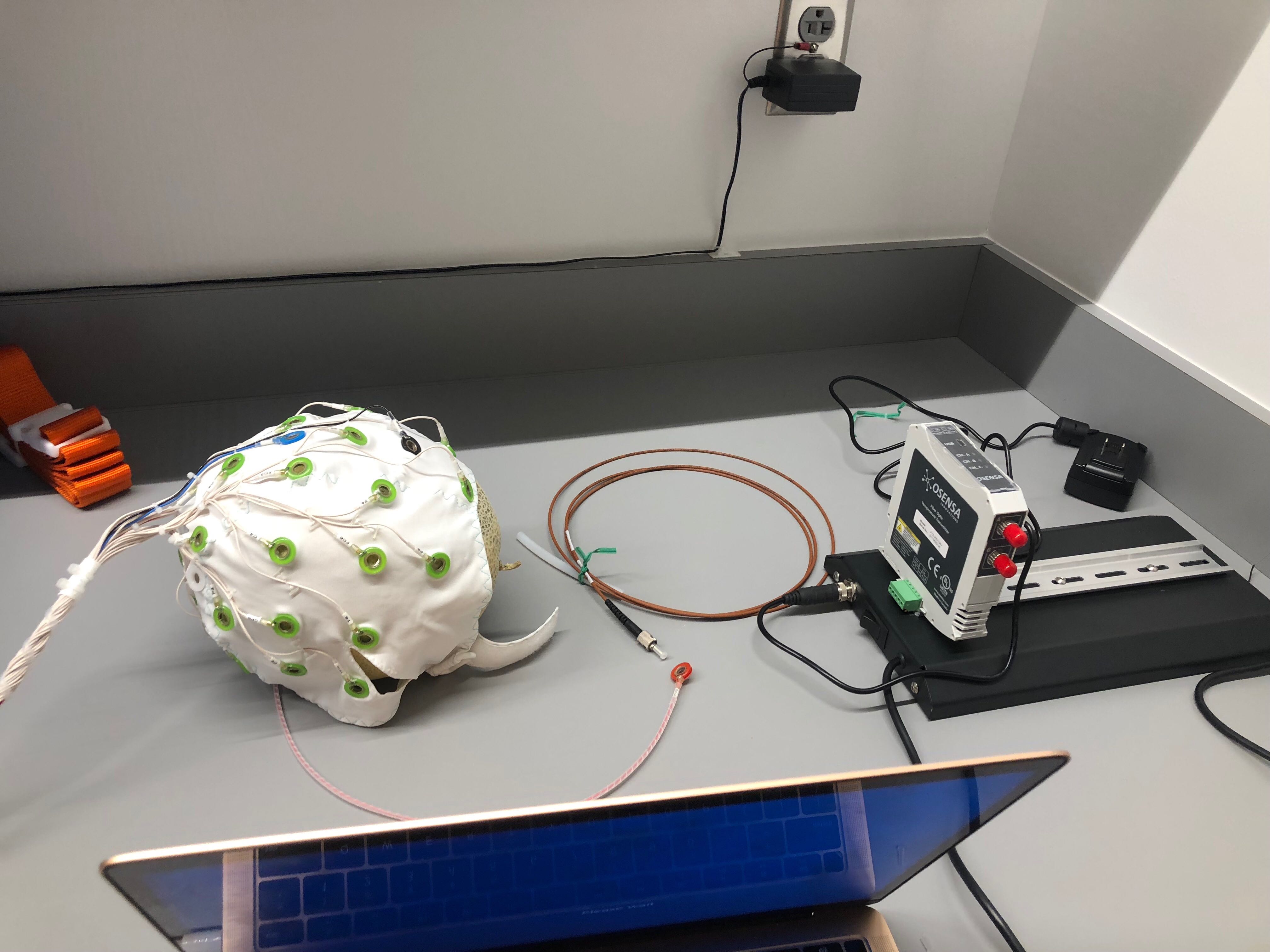
Scalp EEG reaches software through electrodes, an analog front end and a converter. We study research-grade and open hardware before considering any design of our own.
Referencing, filtering, artifact rejection and epoching — every transform fitted on training data only, with eye and muscle channels inspected for confounds.
Based onMNE-Python (opens in a new tab)
Interpretable baselines first: LDA, logistic regression, SVM — tested against shuffled labels. With four balanced classes, chance is 25%. We will report balanced accuracy, macro-F1 and abstention.
Can EEG tell inner speech deliberately addressed to an assistant from ordinary private inner speech? The public dataset has no such labels. This needs a separate, ethically reviewed protocol, measured in false unlocks per hour.
Based onKunz et al., Cell (2025) · implanted electrodes (opens in a new tab)
A fail-closed state machine — locked by default, explicit approval, automatic relock — is implemented alongside the offline EEG pilot. It is software only, tested with synthetic events, and reads no EEG.
Based onUNESCO Recommendation on the Ethics of Neurotechnology (2025) (opens in a new tab)
What published research has demonstrated — and what cannot be inferred from it.
Scalp EEG · imagined speech
Restricted-task classification under experimental conditions.
Universal speech-to-text by thought alone.
Implanted electrodes · attempted speech
Real-time speech synthesis for one participant with ALS, using 256 implanted microelectrodes.
The same performance through scalp EEG.
fMRI · semantic decoder
Tang et al., Nature Neuroscience (2023) (opens in a new tab)
Approximate meaning, with individually trained decoders and cooperating participants.
Portable EEG extracting spontaneous inner speech.
Intracortical stimulation
Limited artificial tactile sensations in clinical research.
Uploading facts or complex AI answers into a brain.
04Technology
From microvolts at the scalp to a message you approved: eight stages, each with a defined boundary.
01 / 08Analog
Electrodes pick up voltage differences produced by the combined activity of large neural populations. The interface to a person is a safety-critical design problem: protection, leakage current and isolation need professional review.
 External reference
We study existing designs before proposing our own. The components below are third-party references; none is a NeuroLink AI product, and none is presumed safe to connect to a person.
An evaluation module or a self-built board is not automatically safe to connect to a person, even on battery power. We have not designed patient-contact hardware, and the project implements no neural stimulation.
05Hardware partner
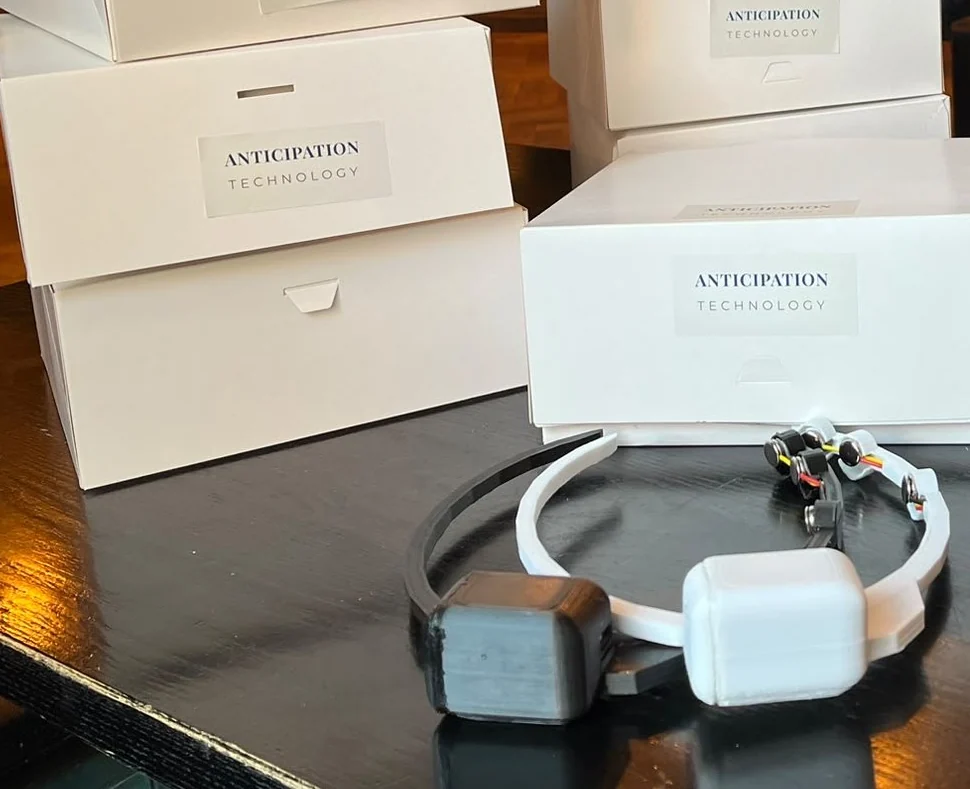
An EEG headband built by Anticipation Technology. We are exploring a collaboration: their hardware to capture the signal, our research and privacy layer on top.
Exploring a collaborationAnticipation Technology (opens in a new tab)
 External reference
Live brain bands
The five EEG frequency bands displayed in real time, with the raw signal alongside.
Light on, light off
A light bulb on screen switched by changes in the headband's signal.
Visuals that react
Animations and particle visuals driven by the incoming signal.
As shown in its maker's demonstration videos. NeuroLink AI has not tested the headband itself.
The headband would cover the acquisition end of the chain. NeuroLink AI's processing, decoder research and Neural Privacy Firewall would sit on top.
It measures broad brain states through band power. It does not decode inner speech; that is still NeuroLink AI's open research question.
Electrodes near the forehead also pick up blinks and muscle activity. Any control demo has to be tested against those artifacts before it can be called brain-driven.
A self-built device in contact with a person needs a professional electrical safety review. Recording volunteers also needs informed consent and careful handling of the data: in the EU, EEG counts as health data.
06Bidirectional communication
Sending a message out of the mind is an open research question. Getting an answer back already has a safe, ordinary route: your senses.
Conceptual illustration
Human → AI
Under investigation. Every step outward passes through a boundary the person controls.
A closed vocabulary first
Four prompted, imagined words in published EEG recordings.
Locked by default
Nothing is decoded until the channel is deliberately opened.
Explicit consent
Only text the person has approved ever reaches the AI.
AI → Human
Responses begin as text and audio. Anything beyond that is a separate research question.
Screen and audio
The starting point. Readable, repeatable, interruptible.
External tactile codes
A possible independent track: a few vibration patterns for states such as yes, no or confirm. Not natural language.
Direct neural stimulation
Regulated clinical research with implanted devices. Outside this project; literature review only.
Direct transfer of complex AI-generated knowledge into the brain is not an established capability.
Clinical studies with implanted electrodes have evoked limited tactile sensations such as shape and motion. That is not the transfer of text, memories or meaning.
NIH Research Matters (2025) (opens in a new tab)Read the document (opens in a new tab)
08Roadmap
Seven objectives, each with an evidence gate. A milestone is complete when its evidence exists — not when a diagram does.
How to read this
Specification and sources are published in this repository.
IS-01 pilot completed: 26.5% balanced accuracy, p = 0.46. No evidence of above-chance performance; cross-subject evaluation pending.
State machine and unit tests are in the repository, driven by synthetic events. Not connected to any neural signal.
NPF-02 protocol proposed; not executed. Nieto2022 does not carry the required intent labels.
Begins only once independent confirmation and cancellation exist.
Screen and audio first. No neural stimulation.
Secondary. It must not hide the decoder's limitations.
Acquisition requirements: AFE, ADC, MCU.
Synthetic digital testbench.
Physical privacy-off switch and state indicator.
Commercial EEG review and bench tests.
FPGA / Verilog, only if measurements justify it.
The repository contains a teaching HDL module and testbench for H1; no simulator run has been recorded as evidence yet.
09Open research
NeuroLink AI is developed in public: the documentation, the reasoning, the limits and the progress.
Read the specifications, question the assumptions, run the tests. If a claim here is not supported by a document in the repository, we want to know.